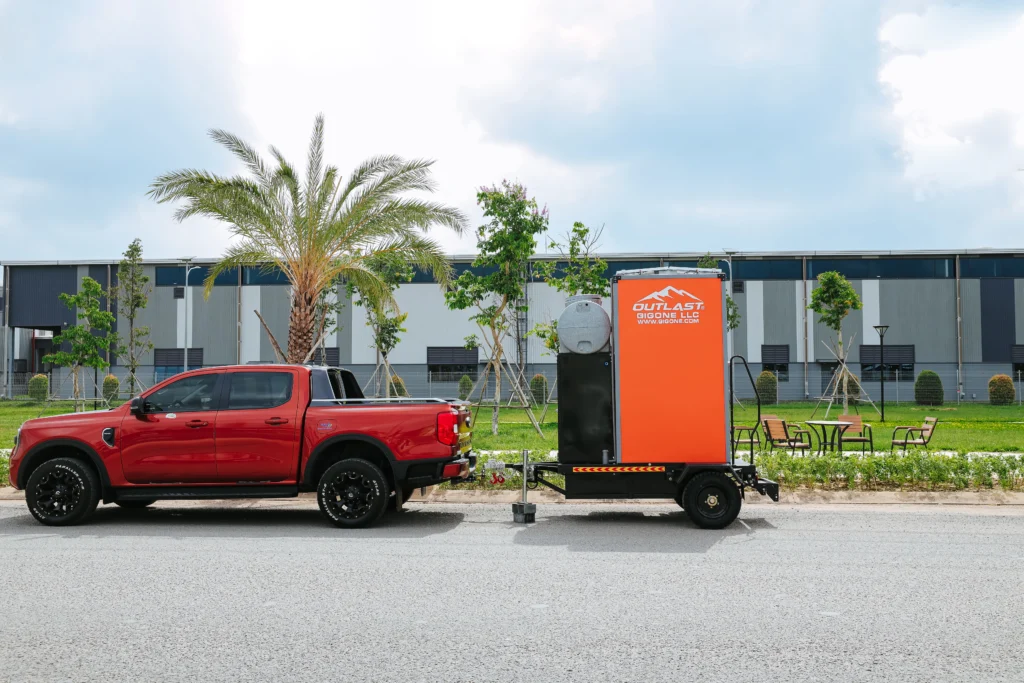

Elevating Portable Restrooms into Infrastructure Support Assets
In today’s deployment environments, sanitation alone is no longer enough. Whether at public events, construction zones, industrial sites, or emergency response areas, users rely heavily on mobile devices for communication, navigation, coordination, and personal safety.
Recognizing this reality, Premium Mobile Oasis™ – Models AA-1P and A-1P are designed not only to deliver reliable sanitation, but also to provide Phone Charging and User Power Amenities as part of an integrated, infrastructure-ready system.
This capability transforms the role of the portable restroom—from a standalone utility into a supportive on-site infrastructure asset that enhances overall site functionality, resilience, and user experience.
Table of Contents
1. Why Power Access Has Become a Public Infrastructure Expectation
Mobile phones and personal electronics are no longer optional accessories. In many environments, they are essential tools.
Users depend on mobile devices to:
- Communicate with teams, supervisors, or family
- Access digital tickets, work orders, or instructions
- Receive safety alerts or emergency notifications
- Navigate large sites or unfamiliar locations
According to the Federal Communications Commission (FCC) and FEMA, maintaining access to communication tools is a key factor in public safety and emergency readiness, particularly during power disruptions or large-scale deployments.
When power access is unavailable, the impact goes beyond inconvenience—it affects safety, coordination, and operational continuity.
2. Phone Charging and User Power Amenities Explained
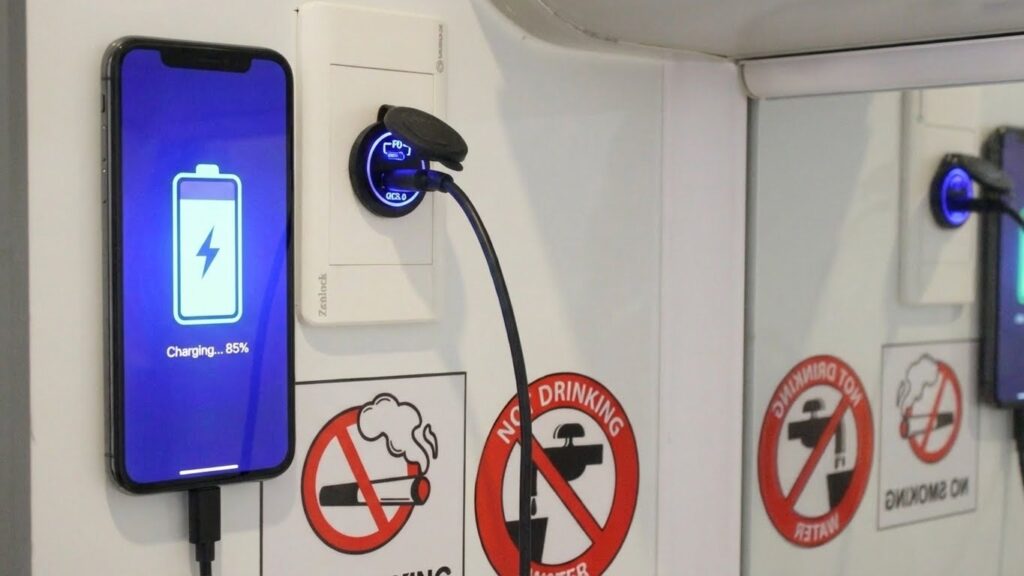
Phone Charging and User Power Amenities in Premium Mobile Oasis™ refer to the integration of:
- USB charging ports
- Type-C charging ports
These ports are compatible with the vast majority of modern smartphones, tablets, and personal electronic devices.
Rather than requiring separate charging stations, temporary generators, or improvised solutions, Models AA-1P and A-1P provide direct on-site charging access within a protected, enclosed environment.
This design choice reflects a broader philosophy: portable restrooms should support real-world user needs, not just minimum sanitation requirements.
3. Designed as Operational Support, Not Consumer Convenience
In Premium Mobile Oasis™ systems, charging ports are not added as luxury features. They are implemented as operational support infrastructure.
Key design considerations include:
- Stable power delivery
- Compatibility with current device standards
- Protection from environmental exposure
- Integration with the unit’s independent power system
The intent is not entertainment or novelty. It is practical functionality—ensuring that users can maintain essential device operation during extended time on site.
4. Enhancing Safety and Communication in Emergency Response Zones
In emergency response and disaster recovery environments, power access can be critical.
During:
- Natural disasters
- Power outages
- Temporary evacuation or relief zones
mobile devices often become the primary channel for:
- Receiving official alerts
- Coordinating with emergency services
- Contacting family members
- Accessing location and shelter information
By providing charging access within a mobile restroom unit, Premium Mobile Oasis™ supports continuity of communication, even when the surrounding infrastructure is compromised.
This capability helps public agencies and response teams maintain safer, more organized operations during high-pressure situations.
5. Supporting Long-Term Construction and Industrial Sites
Construction and industrial projects frequently operate in areas without permanent utilities. Workers may spend long hours on site, often relying on mobile devices for:
- Work coordination and scheduling
- Digital plans and documentation
- Safety reporting and compliance
- Communication across large or segmented sites
Phone Charging and User Power Amenities reduce the need for ad-hoc charging setups and improve overall site efficiency.
For project operators, this means:
- Fewer disruptions
- Better workforce connectivity
- Improved safety communication
In long-term deployments, small operational supports like power access can have a measurable impact on productivity and morale.
6. Value in Large-Scale Public Events
Large events present a unique set of infrastructure challenges:
- High user volume
- Extended operating hours
- Dependence on digital access (tickets, maps, schedules)
Phone charging becomes especially valuable when:
- Events span multiple hours or days
- Attendees rely on mobile apps
- Emergency communication must remain accessible
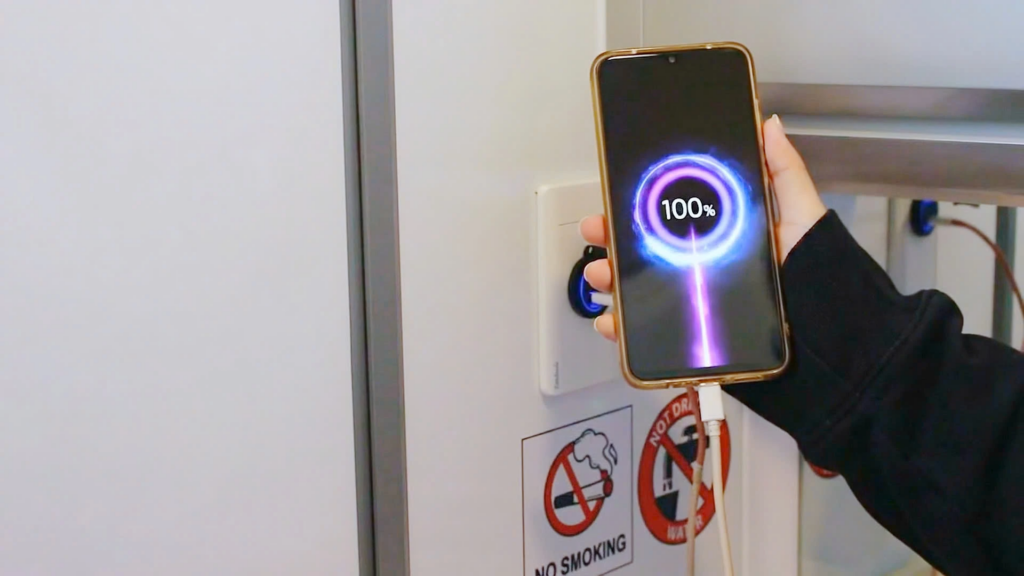
By integrating charging ports directly into restrooms, organizers can:
- Reduce congestion around separate charging stations
- Improve attendee experience
- Enhance overall site usability
Premium Mobile Oasis™ units, therefore, function as multi-purpose service points, not isolated facilities.
7. From Temporary Utility to Infrastructure-Ready Asset
The inclusion of Phone Charging and User Power Amenities reflects a fundamental design shift.
Infrastructure-ready systems are characterized by:
- Multi-functional capability
- Support for long-term or repeated deployment
- User-centric safety and usability
- Integration with broader operational needs
Models AA-1P and A-1P embody this approach by combining sanitation with essential user support functions.
The restroom becomes part of the site’s operational ecosystem, not an afterthought.
8. Integration with Independent and Hybrid Power Systems
Premium Mobile Oasis™ restrooms are engineered for independent operation, allowing power amenities to function without reliance on fixed grid infrastructure.
Charging systems integrate with:
- On-board power generation
- Battery and backup systems
- Hybrid or external power connections when available
This flexibility ensures that charging access remains reliable across:
- Remote locations
- Temporary service zones
- Off-grid deployments
- Emergency environments
Decentralized power access is increasingly recognized as a key factor in resilient infrastructure design.
9. Durability and Long-Term Use Considerations
Public-facing amenities must withstand repeated use. Charging ports in Premium Mobile Oasis™ units are integrated with durability in mind.
Design priorities include:
- Secure mounting
- Protection against moisture and dust
- Long service life aligned with the unit’s 15+ year design lifespan
This ensures that power amenities remain functional over extended deployment cycles, not just during short-term use.
10. Operational Efficiency and Environmental Considerations
By consolidating power access within existing infrastructure, Premium Mobile Oasis™ units reduce the need for:
- Additional charging equipment
- Temporary generators
- Disposable or inefficient power solutions
This approach improves operational efficiency and supports environmentally responsible deployment—important factors in public-sector and B2G applications.
11. Environments Best Suited for Phone Charging and Power Amenities
Phone Charging and User Power Amenities provide the greatest value in:
- Large-scale public events
- Long-term construction and industrial projects
- Emergency response and disaster recovery zones
- Public service and government-managed facilities
- Remote or off-grid deployment areas
Both Model AA-1P and Model A-1P are engineered to support these environments reliably.
Conclusion: Power Access as a Modern Public Service Standard
Phone Charging and User Power Amenities represent more than a convenience—they reflect changing expectations of public infrastructure.
In a connected world, access to power supports:
- Safety
- Communication
- Coordination
- Operational continuity
By integrating USB and Type-C charging ports into a durable, infrastructure-ready restroom system, Premium Mobile Oasis™ – Models AA-1P and Premium Mobile Oasis™ – Models A-1P redefine the role of portable sanitation.
They do not simply serve basic needs.
They support the systems people rely on, even in demanding, temporary, or high-risk environments.
For public agencies, event operators, and infrastructure managers, this capability turns the mobile restroom into a true support asset, not just a temporary utility.